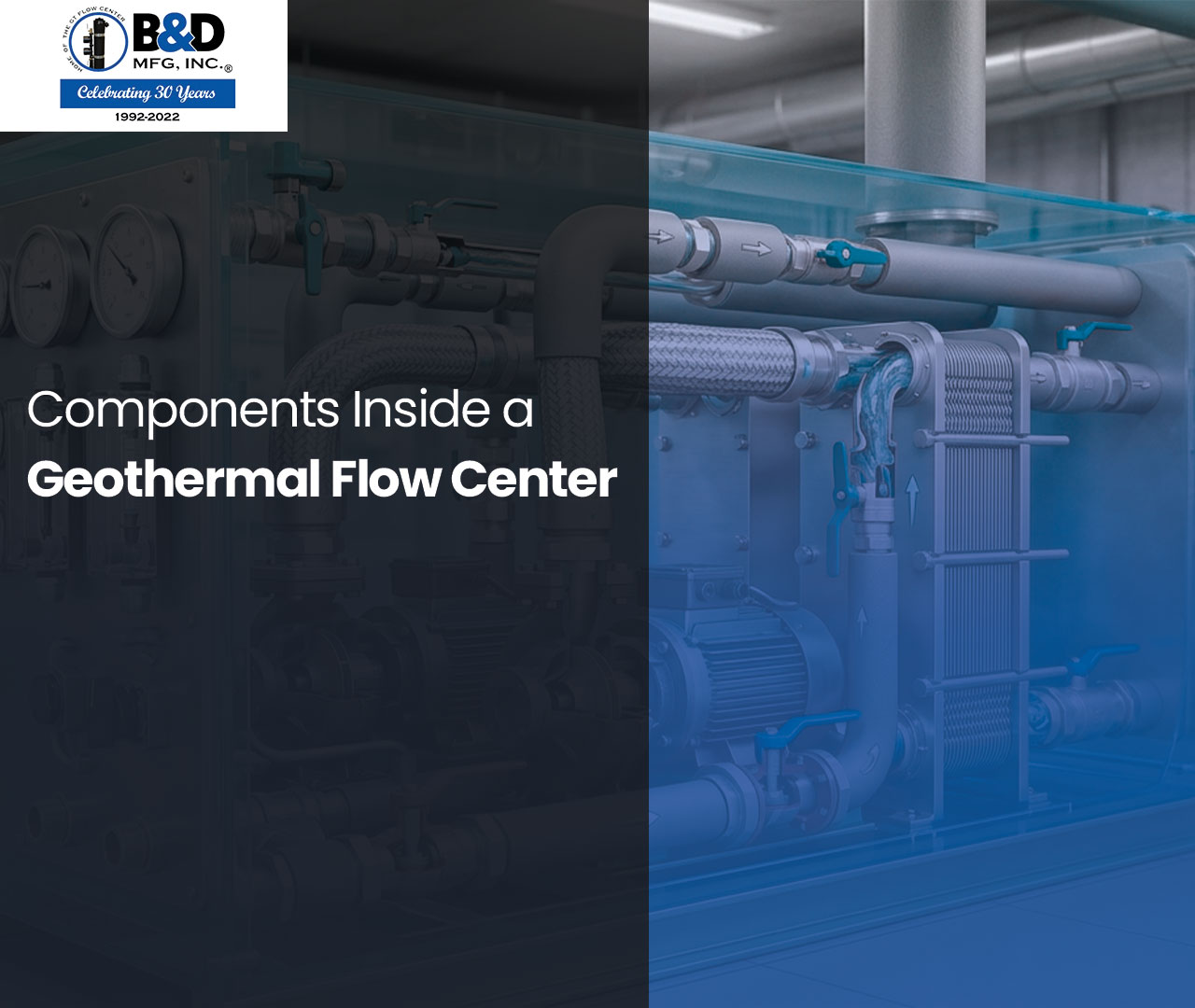
Components Inside a Geothermal Flow Center | B&D Mfg., Inc.
Introduction
If you have ever looked at a geothermal flow center and wondered what is actually going on inside that compact unit, you are not alone. Most homeowners and even some contractors treat it like a black box, fluid goes in, fluid comes out, and the house stays comfortable. But understanding what is inside a geothermal flow center is the key to appreciating why it matters so much, and why choosing a well-built one makes all the difference in long-term performance.
At B&D Mfg., Inc., we have spent decades designing and manufacturing non-pressurized geothermal flow centers for both residential and commercial systems. Every component inside our units is selected and engineered to protect your loop system, extend equipment life, and simplify installation and maintenance. This guide breaks down each of those components so you know exactly what your flow center is doing for you every single day.
Explore B&D Mfg., Inc. Flow Center Products
What Is a Geothermal Flow Center?
Before diving into the individual parts, it helps to understand what a geothermal flow center actually does as a whole. A geothermal flow center is a pre-assembled pumping station that circulates fluid between your earth loop and your heat pump unit. It acts as the central hub of your closed-loop geothermal system, managing fluid flow, eliminating air, and protecting the pumps that keep everything running.
Unlike loosely assembled field-built systems, a factory-packaged flow center like those made by B&D Mfg., Inc. arrives ready to connect. You simply attach the return line from the earth loop, connect the supply line to the heat pump, and the system is ready to operate. That simplicity on the outside, however, is made possible by a carefully designed set of components on the inside.
Key Components Inside a Geothermal Flow Center
1. Circulation Pumps
The circulation pump is the engine of the flow center. It drives fluid through the earth loop continuously, ensuring heat exchange never stops. In a non-pressurized flow center, the pump is fully protected from running dry through built-in design features that keep it submerged in fluid at all times.
B&D Mfg., Inc. flow centers are compatible with Grundfos pumps, which are among the most trusted names in the industry. These pumps are designed for quiet, reliable, energy-efficient operation over the long life of a geothermal system. Depending on system size and loop configuration, flow centers may house one or two pumps to meet flow rate requirements.
The pump is also the only moving part in the entire flow center, which means service needs are minimal. When maintenance is required, each pump is designed to be removed and serviced without risk of fluid loss or air entry into the system.
2. Air Elimination Chamber
One of the most important and often overlooked components inside a geothermal flow center is the air elimination chamber. Air trapped inside a closed-loop geothermal system is a serious problem. It reduces heat transfer efficiency, causes pump cavitation, and can lead to premature equipment failure.
In a non-pressurized flow center like those made by B&D Mfg., Inc., the reservoir and chamber design continuously separates air from the circulating fluid. As fluid returns from the earth loop, any entrained air rises naturally to the top of the chamber and is released, while the fluid continues circulating through the system. This passive air elimination process runs automatically without any additional equipment or manual intervention.
This built-in capability is one of the reasons why non-pressurized flow centers eliminate the need for a flush cart when your header or manifold is located indoors. The flow center itself handles air purging during the fill and flush process.
3. Reservoir and Fluid Chamber
The reservoir is the holding area that stores and manages system fluid. In a non-pressurized design, this open reservoir operates at atmospheric pressure, allowing fluid to expand and contract naturally as temperatures change throughout the system cycle.
The reservoir also serves as the fill point for antifreeze or water. On B&D Mfg., Inc. flow centers, adding fluid is as simple as removing the self-sealing lid and pouring the antifreeze directly into the air elimination chamber. There are no complex pressurized fittings or specialized tools required.
The fluid level in the reservoir should be maintained at a consistent level, on GT® models, this means filled to the bottom of the elbow, and on QT® models, to the top of the elbow. Monitoring this is straightforward and requires no special equipment.
4. Self-Sealing Lid
The self-sealing lid sits at the top of the flow center and serves a dual purpose. First, it seals the reservoir to keep dirt, debris, and contaminants out of the system fluid. Second, it allows the system to remain accessible for fluid additions, visual inspection, and quick servicing without any tools required.
This lid is designed to be hand-tightened only. Over-tightening is unnecessary and can damage the seal. The self-sealing design means that even if the lid is removed during routine maintenance, the system remains protected from contamination as soon as the lid is replaced.
This small but thoughtful component contributes directly to the cleaner, longer-lasting performance that B&D Mfg., Inc. flow centers are known for in the field.
Contact B&D Mfg., Inc. for Expert Guidance on the Right Flow Center for Your System
5. Ball Valves
Ball valves are positioned within the flow center to allow technicians to control fluid flow, isolate components, and perform service without draining the entire system. Most flow centers include both a top ball valve and additional valves at key connection points.
One important note when it comes to flow throttling: pumps should be throttled at the heat pump whenever possible. If no valves are available at the heat pump, the top ball valve on the flow center can be used. The bottom ball valve should never be used for throttling, as doing so can damage the pump.
Proper valve positioning and operation is a simple but critical part of keeping the system balanced and running at peak efficiency.
6. Flow Meter
Knowing the actual flow rate through your loop system is essential for confirming proper system performance. Without a flow meter, technicians are left guessing or using indirect pressure-drop methods that can introduce significant uncertainty.
B&D Mfg., Inc. offers an exclusive Flowmeter Tool as an accessory that provides a direct reading of system flow rate. Available in three sizes to match different system requirements, this tool is the most reliable and straightforward way to verify that your loop is circulating at the correct rate for maximum heat exchange efficiency.
In-line flow meters in the WF-400N and WF-452 series are also available, offering excellent accuracy and repeatability for permanent installation within the system.
7. Pump Protection Feature
One of the defining design elements of B&D Mfg., Inc. flow centers is the built-in patented pump protection feature. This feature ensures that the circulating pump is never exposed to a dry-run condition, which is one of the most common causes of pump failure in geothermal systems.
The pump protection design keeps the pump submerged in fluid at all times, eliminating the need for additional external pump protection devices. This means fewer components, simpler installation, and greater long-term reliability for the entire system.
This feature is part of what makes the GT® and QT® flow centers so popular among geothermal contractors who want to reduce callbacks and give homeowners a system that simply works without complications.
8. Cabinet and Housing
The outer cabinet is more than just a shell, it plays an important role in protecting internal components and making the system practical for real-world installation environments.
The QT® flow center, for example, features a stylish rugged insulated cabinet that is designed for flexible installation. The attractive appearance means it does not need to be hidden away in a utility room. It can be mounted on a wall or floor and looks professional in any mechanical space.
The insulated design also helps prevent condensation on cold fluid lines, which protects the surrounding installation area and reduces the risk of moisture-related issues over time.
9. Connection Ports and Fittings
Every flow center includes inlet and outlet connection ports designed to make system hookup straightforward. The return line from the earth loop connects to the flow center, and the supply line runs from the flow center to the heat pump unit.
B&D Mfg., Inc. flow centers are factory packaged and arrive ready to connect, so there is no field assembly required for the core unit. This reduces the chance of installation errors and ensures the internal components are already correctly configured before the unit ever arrives on the job site.
For systems with multiple heat pumps on a single loop field, the EA Series flow center is designed specifically for 6 to 10 ton split coil applications, with dual pump circuits and a stainless steel construction that incorporates the same non-pressurized features as all other B&D Mfg., Inc. models.
How All These Components Work Together
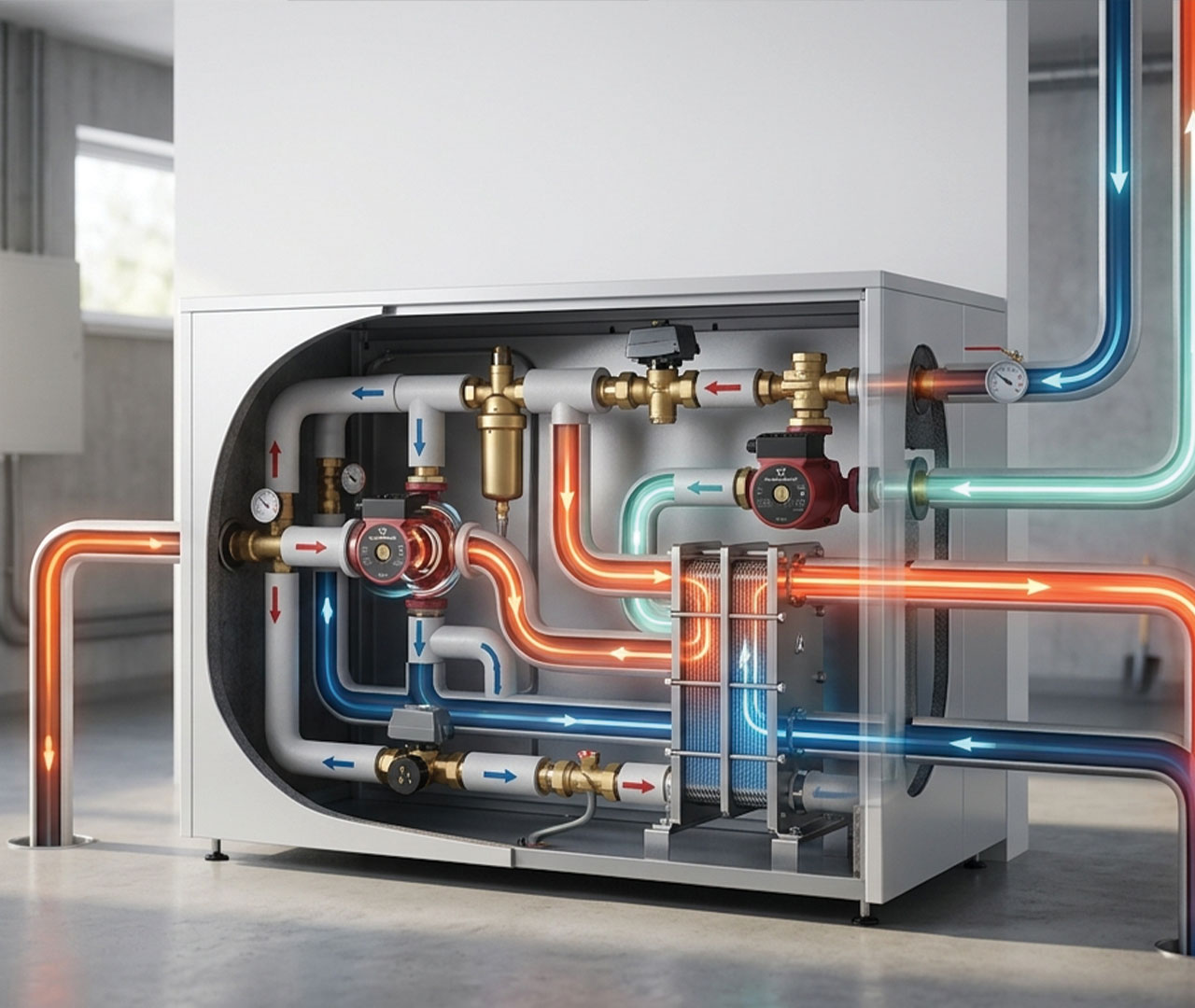
Understanding the individual components is useful, but it is equally important to understand how they function as a complete system. Here is the sequence that happens every time your geothermal system runs:
Fluid that has exchanged heat with the earth returns through the loop back to the flow center. It enters the air elimination chamber, where any trapped air separates and rises while the fluid continues downward into the reservoir. The circulation pump draws fluid from the reservoir and pushes it through the supply line to the heat pump, where it exchanges heat with the refrigerant circuit to heat or cool your home. The fluid then returns to the earth loop to begin the cycle again.
All of this happens continuously and quietly, managed entirely by the components inside your flow center. The self-sealing lid keeps contaminants out. The ball valves allow precise flow control. The pump protection feature keeps the pump safe. And the Flowmeter Tool gives technicians the visibility they need to confirm everything is running correctly.
Why Component Quality Matters in a Geothermal Flow Center
Not all flow centers are built the same way. A system that uses low-quality pumps, poorly designed valves, or a reservoir without proper air elimination will cost more in service calls, repairs, and shortened equipment life than any initial savings on the unit itself.
B&D Mfg., Inc. has built its reputation by engineering flow centers that reduce callbacks, simplify maintenance, and protect the homeowner's investment in their geothermal system. Every component is selected for durability, and the entire unit is factory assembled and tested before it leaves the facility.
For contractors, that means faster installation and fewer problems. For homeowners, it means confidence that the system will perform reliably for years to come.
Request a Quote from B&D Mfg., Inc. Today
Components to Consider When Selecting a Flow Center
When comparing geothermal flow centers, here are the component-level factors that deserve your attention:
Pump quality and compatibility, Look for systems that support high-performance pumps like Grundfos and that are designed to protect pumps from dry-run conditions.
Air elimination design, A built-in air elimination chamber removes the need for separate air purging equipment and simplifies the fill and flush process.
Reservoir accessibility, Easy fluid access means faster maintenance and the ability to add antifreeze without specialized tools.
Valve configuration, Proper ball valve placement ensures flow can be controlled and components isolated without disrupting the entire system.
Cabinet protection, An insulated, durable cabinet protects internal components and reduces installation constraints.
Flow measurement capability, Whether through a built-in meter or an accessory tool, the ability to measure flow rate accurately is essential for system verification and long-term performance monitoring.
Common Mistakes Related to Flow Center Components
Even with high-quality components, certain mistakes in installation and operation can undermine system performance:
Throttling at the wrong valve, Always throttle at the heat pump or at the top ball valve of the flow center. Never use the bottom ball valve for throttling.
Incorrect fluid level, The fluid level in the reservoir must be maintained at the correct position. On GT® models this means the bottom of the elbow; on QT® models it means the top of the elbow.
Over-tightening the lid, The self-sealing lid should be hand-tight only. Over-tightening can damage the seal and compromise the self-sealing function.
Running multiple flow centers on a shared loop field, Using more than one flow center on a common loop field will cause pumps to work against each other, which can lead to lids blowing off and serious performance issues. One flow center per loop field is the correct configuration.
Skipping flow verification, Never assume the system is flowing at the correct rate. Use a Flowmeter Tool to get a direct reading and eliminate uncertainty.
Future Developments in Geothermal Flow Center Design
As the geothermal industry continues to grow, manufacturers are developing flow center components that are more energy-efficient, more compact, and more integrated with modern building controls. Smart monitoring capabilities, improved pump technologies, and advanced air separation designs are all areas where innovation is ongoing.
B&D Mfg., Inc. continues to develop and refine its product line to meet the evolving needs of contractors and homeowners, maintaining the core principles of simple installation, easy maintenance, and long-term reliability that have defined the company's products for decades.
Conclusion
A geothermal flow center may look simple from the outside, but the components inside each one are working together to protect your loop system, maintain fluid circulation, eliminate air, and ensure consistent heat exchange performance year after year. From the circulation pump and air elimination chamber to the self-sealing lid and built-in pump protection feature, every element inside a B&D Mfg., Inc. flow center has a specific job to do.
Understanding those components helps you make better decisions when selecting, installing, and maintaining a geothermal system. And when you choose a flow center built with quality components from a manufacturer who has been focused on geothermal systems for decades, you are giving your system the best possible foundation for long-term success.
FAQs
1. What is the most important component inside a geothermal flow center?
Every component plays a role, but the circulation pump and air elimination chamber are arguably the most critical. The pump drives fluid circulation, and the air elimination chamber continuously removes air to protect efficiency and equipment.
2. Can I add antifreeze directly to a B&D Mfg., Inc. flow center?
Yes. Simply remove the self-sealing lid on the top of the flow center and pour antifreeze directly into the air elimination chamber. No specialized fittings or tools are required.
3. How do I check the flow rate of my geothermal system?
B&D Mfg., Inc. offers an exclusive Flowmeter Tool that provides a direct reading of system flow rate. It is available in three sizes and is the most accurate way to verify that your loop is circulating at the correct rate.
4. Why should I not use multiple flow centers on one loop field?
Using more than one flow center on a common loop field causes the pumps to fight against each other, which can result in lids blowing off and significant system damage. Always use a single flow center per loop field.
5. Do B&D Mfg., Inc. flow centers require a flush cart during installation?
Not if your manifold is located indoors. The built-in pump protection and air elimination design handles purging internally. A flush cart is only needed if your header or manifold is located outside.