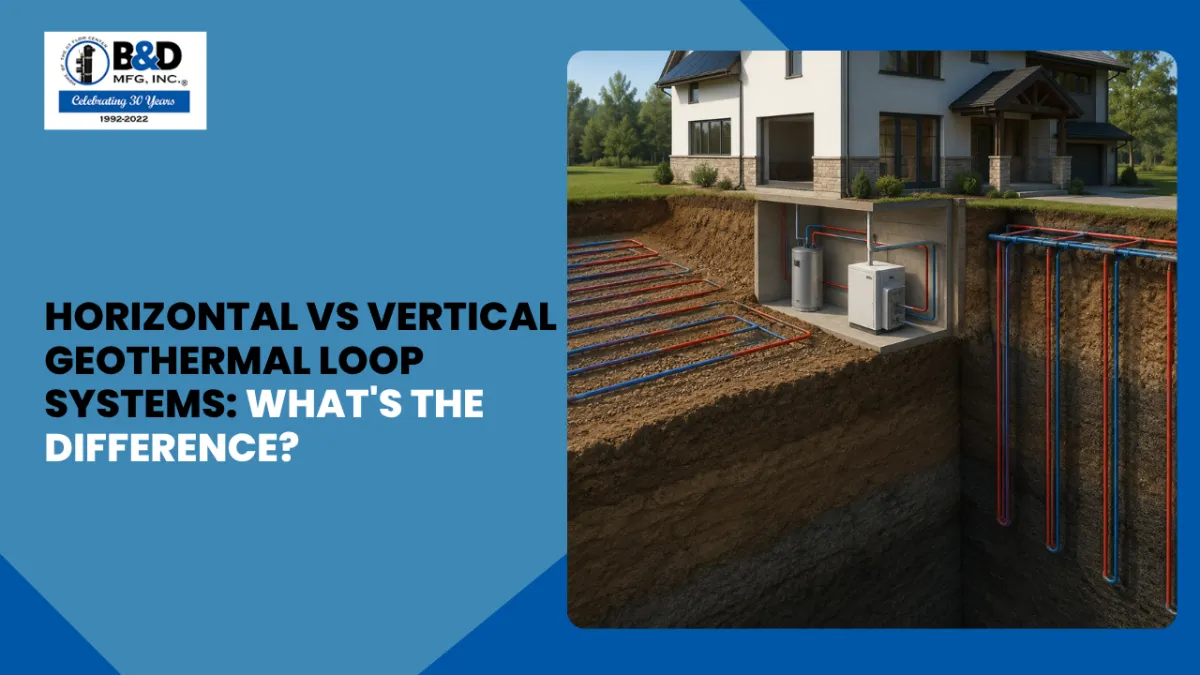
Horizontal vs Vertical Geothermal Loop Systems: What's the Difference?
Choosing between a horizontal and vertical geothermal loop system is one of the first decisions in planning a geothermal heating and cooling installation. Both loop types move heat between the ground and a building, but they work in different ways and fit different properties. Understanding how horizontal and vertical geothermal loops compare helps installers and property owners plan a system that performs well and fits the site.
What Is a Geothermal Loop System?
A geothermal loop system is a network of buried HDPE pipe that circulates a water-based fluid underground. As the fluid moves through the loop, it absorbs or releases heat to the surrounding earth, which stays at a fairly constant temperature year-round below the frost line. That heat exchange is what allows a geothermal heat pump to warm or cool a building using far less energy than a conventional system.
The two most common loop designs are horizontal and vertical. Both rely on the same basic principle, but the layout, depth, and installation process are very different.
Horizontal Geothermal Loop Systems
A horizontal loop system runs pipe through trenches dug roughly 4 to 6 feet below the surface, arranged in parallel rows or coils across an open area of land.
How Horizontal Loops Work
Installers dig a series of trenches and lay one or more pipe runs in each one, then backfill and connect the pipes to a header that routes fluid to and from the building. Because the pipe stays close to the surface, the ground temperature it draws from shifts more with the seasons than it does at greater depth.
Advantages
Lower installation cost in most cases, since trenching equipment is less expensive to run than a drilling rig
Straightforward installation on properties with enough open land
Easier to expand or repair, since the pipe sits closer to the surface
Trade-Offs
Requires a large area of land, generally proportional to the size of the heating and cooling load
More exposed to surface weather and seasonal temperature swings than a deep vertical loop
Not practical for small lots, rocky sites, or properties with mature landscaping
Vertical Geothermal Loop Systems
A vertical loop system uses one or more boreholes drilled straight down, often 150 to 400 feet or more, with U-shaped pipe inserted into each hole and connected to a header at the surface.
How Vertical Loops Work
A drilling rig bores a narrow, deep hole, and a U-bend pipe assembly is lowered in and grouted in place to ensure good contact with the surrounding earth. Multiple boreholes are typically connected to a common header, similar to a horizontal system, before running to the building's flow center.
Advantages
Small surface footprint, which makes it a fit for tight urban and suburban lots
Access to more stable ground temperatures at depth, which can support consistent year-round performance
Minimal disruption to existing landscaping, driveways, or hardscaping once installation is complete
Trade-Offs
Higher upfront cost, largely due to drilling equipment and labor
Requires specialized drilling access and, in some areas, permitting for borehole depth
Grouting and pipe placement need to be done correctly to maintain good heat transfer
Horizontal vs Vertical Geothermal Loops: Side-by-Side Comparison
How to Choose the Right Loop System

The right geothermal loop type usually comes down to three factors: available land, soil and rock conditions, and budget.
Available land: A horizontal loop needs open space; a vertical loop is the better fit when land is limited.
Site conditions: Rocky or shallow soil can make trenching difficult, which may favor a vertical design even on larger lots.
Budget and long-term goals: Horizontal loops typically cost less upfront, while vertical loops can offer more consistent performance and a smaller footprint over the life of the system.
Many installers evaluate the property first, then confirm which loop type the site can support before finalizing the design and ordering fittings and equipment.
Reliable Fittings and Flow Centers for Either Loop Type
Whether a project uses a horizontal or vertical loop, the quality of the fittings, headers, and flow center behind the system plays a direct role in long-term performance. B&D Mfg. supplies HDPE butt fusion fittings built for reliable, leak-tight loop connections, along with non-pressurized flow centers and underground headers designed to tie horizontal and vertical loop runs back to the building's mechanical system.
Frequently Asked Questions
Is a horizontal or vertical geothermal loop better?
Neither type is better in every situation. Horizontal loops tend to cost less and suit properties with open land, while vertical loops fit smaller lots and can offer more stable ground temperatures. The right choice depends on the specific site.
How much land does a horizontal geothermal loop need?
The amount of land depends on the size of the home's heating and cooling load and the specific loop configuration used, so it's best confirmed during a site evaluation.
How deep are vertical geothermal boreholes?
Vertical boreholes commonly range from about 150 to 400 feet or more, depending on the equipment's capacity and local ground conditions.
Can a property use a mix of horizontal and vertical loops?
Yes. Some sites use a hybrid approach, combining horizontal and vertical sections to work around space constraints or ground conditions while still meeting the system's heating and cooling needs.
What fittings are used to connect geothermal loop pipe?
HDPE loop pipe is most commonly joined with butt fusion or electrofusion fittings, which create a permanent, leak-tight seal appropriate for buried loop applications.
Planning a geothermal loop installation and need fittings or a flow center to match? Browse B&D Mfg.'s geothermal products or contact the team for help selecting the right components for a horizontal or vertical loop project.
Related reading: Visit the Geothermal Blog for more installation guides.