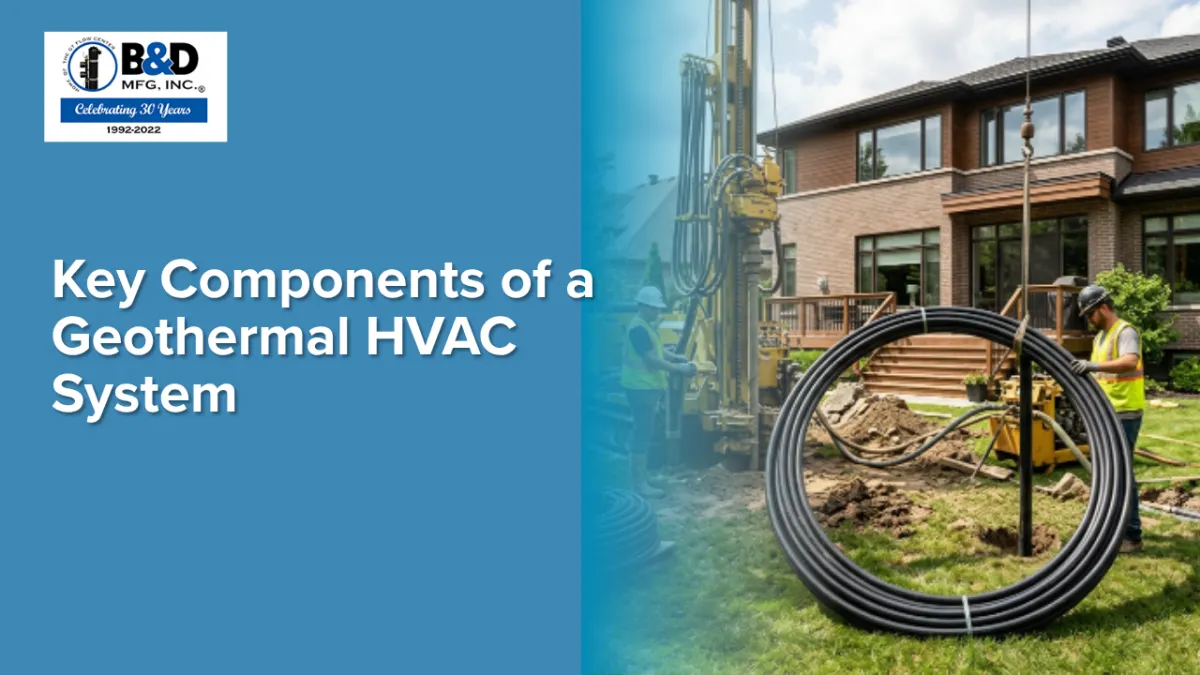
Key Components of a Geothermal HVAC System | B&D Mfg., Inc.
Why Geothermal HVAC?
Geothermal HVAC systems represent one of the most efficient, reliable, and environmentally responsible heating and cooling technologies available today. Unlike conventional systems that generate heat by burning fuel or transfer heat from outdoor air, geothermal systems harness the stable thermal energy stored just beneath the earth's surface, a resource that remains at a consistent temperature year-round regardless of outdoor conditions.
Understanding the key geothermal HVAC components that make these systems work is essential for homeowners evaluating an upgrade, contractors specifying installations, and distributors sourcing quality parts. At B&D Mfg., Inc. manufacturers of non-pressurized geothermal flow centers, air handlers, and buffer tanks since 1992, we believe an informed industry is a stronger one.
This guide walks you through every major geothermal system component, what it does, why it matters, and how each part contributes to the system's legendary efficiency.
1. The Ground Loop (Earth Heat Exchanger)
Primary Geothermal Component: The Source of All Energy
The ground loop is the backbone of any geothermal system. It consists of a continuous circuit of high-density polyethylene (HDPE) pipe buried in the earth, through which a heat-transfer fluid — typically a water-antifreeze solution, circulates continuously. The loop extracts heat from the ground in winter and rejects heat into the ground in summer.
Because ground temperatures below the frost line remain relatively stable (typically 45°F to 75°F depending on geography), the loop provides a consistent thermal source that outperforms outdoor air in both extreme cold and extreme heat.
Ground Loop Configurations
Horizontal loops: Installed in shallow trenches (4–6 ft deep); cost-effective where land is available.
Vertical loops: Drilled boreholes (150–400 ft deep); ideal for limited land area.
Pond/lake loops: Submerged in a body of water; highly efficient and lower installation cost.
Open-loop systems: Draw and return groundwater directly; simple but require water quality testing.
B&D Mfg. Tip: We supply premium HDPE pipe and HDPE fittings engineered specifically for geothermal loop applications, built for decades of subsurface service. Proper pipe selection directly impacts system longevity and efficiency.
2. The Geothermal Heat Pump (Ground Source Heat Pump)
The Heart of the Geothermal System
The geothermal heat pump is the central processing unit of the system. It transfers thermal energy between the ground loop and your building's distribution system using a refrigeration cycle. In heating mode, it extracts low-grade heat from the loop fluid and upgrades it to usable space-heating temperatures. In cooling mode, it reverses — pulling heat from indoor air and rejecting it into the earth.
Modern geothermal heat pumps achieve Coefficient of Performance (COP) ratings of 3.0 to 5.0, meaning they deliver 3 to 5 units of heating or cooling energy for every 1 unit of electrical energy consumed. This makes them 3–5x more efficient than the best fossil-fuel furnaces.
Key Heat Pump Sub-Components
Compressor: The workhorse — pressurizes refrigerant to raise or lower its temperature.
Refrigerant-to-water heat exchanger (coaxial coil): Transfers heat between refrigerant and loop fluid.
Refrigerant-to-air heat exchanger (desuperheater): Captures waste heat for domestic hot water production.
Reversing valve: Switches the system between heating and cooling modes.
Expansion valve: Regulates refrigerant flow and pressure drop across the cycle.
3. The Flow Center
Critical Geothermal HVAC Component: Loop Fluid Management
The flow center is one of the most critical, and most often overlooked, geothermal system components. Its job is to circulate the heat-transfer fluid through the ground loop and the heat pump continuously and efficiently. Think of it as the "heart" of the loop: without it, no thermal exchange occurs.
B&D Mfg., Inc. specializes in non-pressurized flow centers, which offer significant advantages over pressurized alternatives: simpler servicing, no pressure vessel requirements, easier fluid management, and reduced risk of catastrophic failure.
What a Non-Pressurized Flow Center Includes
Circulation pumps: Drive fluid movement through the loop (single or dual pump configurations).
Expansion tank: Accommodates fluid volume changes with temperature — without requiring a pressurized vessel.
Isolation valves and ball valves: Enable service without draining the loop.
Air purger/separator: Removes entrained air that reduces heat transfer efficiency.
Fill port and hose connections: Allow fluid addition and system purging.
Integrated cabinet: Houses all components in a compact, wall-mounted assembly.
B&D Mfg. Product Note: Our QT Flow Center and full flow center line are manufactured in-house in Scranton, Iowa, giving distributors consistent quality and reliable lead times. We offer single-pump and dual-pump configurations for residential and light commercial applications.
4. The Air Handler
Delivering Comfort, The Indoor Distribution Component
The air handler is the indoor unit that conditions and distributes air throughout the building. In a geothermal HVAC system, the air handler works in tandem with the heat pump, using the thermal energy delivered to move heated or cooled air through the duct system.
B&D Mfg. manufactures custom air handlers designed specifically for geothermal applications, ensuring compatibility and peak performance when matched with our flow centers and buffer tanks.
Core Air Handler Components
Blower motor: Moves air across the heat exchanger coil and into the duct system.
Evaporator/condenser coil: The interface between refrigerant and indoor air for heat transfer.
Filter rack: Protects the coil and blower from airborne particulates.
Auxiliary/backup heat strip: Provides supplemental heat during peak demand or defrost cycles.
Cabinet and duct connections: Provide structural housing and interface to the distribution system.
5. The Buffer Tank
System Stabilization & Hot Water Integration
A buffer tank — also called a thermal storage tank or hot water buffer — is a critical geothermal system component in hydronic heating applications and in systems with desuperheater hot water generation. It serves as a thermal battery, storing heated water to smooth out demand spikes and protect the heat pump from short-cycling.
Short-cycling (the heat pump turning on and off in rapid succession) is one of the leading causes of premature heat pump failure. A properly sized buffer tank extends run cycles, stabilizes system temperature, and dramatically improves equipment longevity.
Buffer Tank Applications in Geothermal Systems
Domestic hot water pre-heat: Captures waste heat from the desuperheater for free water heating.
Radiant floor buffer: Stores heated water for hydronic radiant floor distribution.
Zoned system stabilization: Prevents short-cycling when zone demands are small relative to heat pump capacity.
Commercial load balancing: Bridges the gap between generation capacity and variable demand.
B&D Mfg. Note: We manufacture buffer tanks in a range of capacities for both residential and commercial geothermal systems. Our tanks are engineered to integrate seamlessly with our flow centers and are built to the high standards expected in geothermal hydronic applications.
6. Manifolds & Distribution Piping
Loop Field Management & Fluid Distribution
In systems with multiple ground loop bores or trenches, a manifold system combines the individual loop runs into a single supply and return header. This centralized distribution point allows for balanced flow across all loops and simplifies servicing.
B&D Mfg. supplies manifolds and specialty fittings designed specifically for geothermal loop fields. Proper manifold design is essential for balanced flow, which ensures each loop bore contributes equally to the system's thermal exchange capacity.
Key Manifold & Piping Considerations
Header manifold sizing: Must be sized to deliver balanced flow to all loop runs without excessive pressure drop.
Purge ports: Allow individual loop circuits to be flushed and air-purged independently.
Isolation valves: Enable individual loop circuits to be isolated for testing or service.
HDPE fusion fittings: Provide leak-free, long-life connections in subsurface applications.
Insulation: Above-grade piping should be insulated to prevent heat gain/loss before the fluid reaches the heat pump.
7. Thermostat & Controls

Intelligent System Management
Modern geothermal HVAC systems rely on sophisticated thermostats and control systems to maximize efficiency and comfort. Unlike simple on/off thermostats, geothermal-compatible controls manage multi-stage operation, emergency heat activation, desuperheater priority, and zoning across multiple areas.
Control System Features to Look For
Two-stage or variable-speed compressor control: Matches output to demand for maximum efficiency.
Desuperheater management: Prioritizes domestic hot water generation when conditions allow.
Auxiliary heat lockout: Prevents backup heat from activating unless truly necessary.
Fault monitoring and diagnostics: Alerts homeowners and contractors to system issues early.
Smart/connected thermostat compatibility: Enables remote monitoring and scheduling.
8. Loop Heat Transfer Fluid
The Working Medium of the Ground Loop
The fluid circulating through the ground loop is itself a critical geothermal component. In most closed-loop systems, this is a mixture of water and antifreeze — typically propylene glycol (food-grade) or methanol — blended to a concentration that prevents freezing at the lowest expected ground temperature.
Fluid selection affects heat transfer efficiency, pump energy consumption, and corrosion rates. The fluid must be properly maintained over the life of the system and should be tested periodically for pH, freeze protection level, and inhibitor concentration.
Common Loop Fluid Options
Propylene glycol / water blend: Non-toxic, food-grade; preferred for environmentally sensitive installations.
Methanol / water blend: Excellent heat transfer; requires careful handling and containment.
Pure water: Used only in climates where freezing is not a risk (open-loop systems).
How Geothermal Components Work Together
A geothermal HVAC system is only as strong as the integration of its components. Each part — from the ground loop and heat pump to the flow center, air handler, buffer tank, and manifold — must be properly sized, matched, and installed to deliver the efficiency and comfort that make geothermal systems worth the investment.
Here's a simplified operational sequence:
The flow center pumps heat-transfer fluid through the buried ground loop, where it absorbs heat from (or rejects heat to) the earth.
The warm (or cool) loop fluid enters the geothermal heat pump, where the refrigeration cycle upgrades or downgrades the temperature.
The heat pump delivers conditioned refrigerant to the air handler, which blows heated or cooled air through the duct system.
In hydronic applications, the heat pump heats water stored in a buffer tank, which feeds radiant floor circuits or fan coil units.
The thermostat monitors conditions and manages staging, zoning, and auxiliary heat to maintain comfort at the lowest energy cost.
The Bottom Line: Every geothermal system component plays a defined role. Specifying quality components from trusted manufacturers — and ensuring they are properly matched — is the single greatest factor in system longevity and efficiency.
Why Geothermal Contractors & Distributors Choose B&D Mfg., Inc.
Since 1992, B&D Mfg., Inc. has been at the forefront of geothermal component manufacturing. Based in Scranton, Iowa, we manufacture non-pressurized flow centers, air handlers, and buffer tanks in-house — giving our distributor network consistent quality, competitive pricing, and reliable inventory.
Our Geothermal Product Line Includes
Non-pressurized flow centers (single and dual pump configurations)
Custom air handlers for geothermal applications
Buffer tanks for hydronic and domestic hot water integration
HDPE pipe and HDPE fittings for ground loop construction
Manifolds and specialty geothermal fittings
Fusion tools and accessories
Our mission is simple: to bring geothermal innovation to the forefront of green energy using non-pressurized products that meet every geothermal need — with the products our distributors need, in stock, when they need them.
Conclusion
Geothermal HVAC systems deliver unmatched efficiency, comfort, and environmental performance, but only when every geothermal system component is properly specified, installed, and maintained. From the ground loop and heat pump to the flow center, air handler, and buffer tank, each element plays an essential role in the system's performance.
Whether you're a homeowner exploring geothermal for the first time, a contractor specifying components for a new installation, or a distributor evaluating product lines, understanding these geothermal HVAC components empowers better decisions.
B&D Mfg., Inc. is here to support the industry with the quality geothermal components, knowledgeable service, and stocked inventory that today's projects demand.
Ready to source geothermal components you can trust? Contact B&D Mfg., Inc. at [email protected] or visit www.bdmfginc.com to request pricing access.