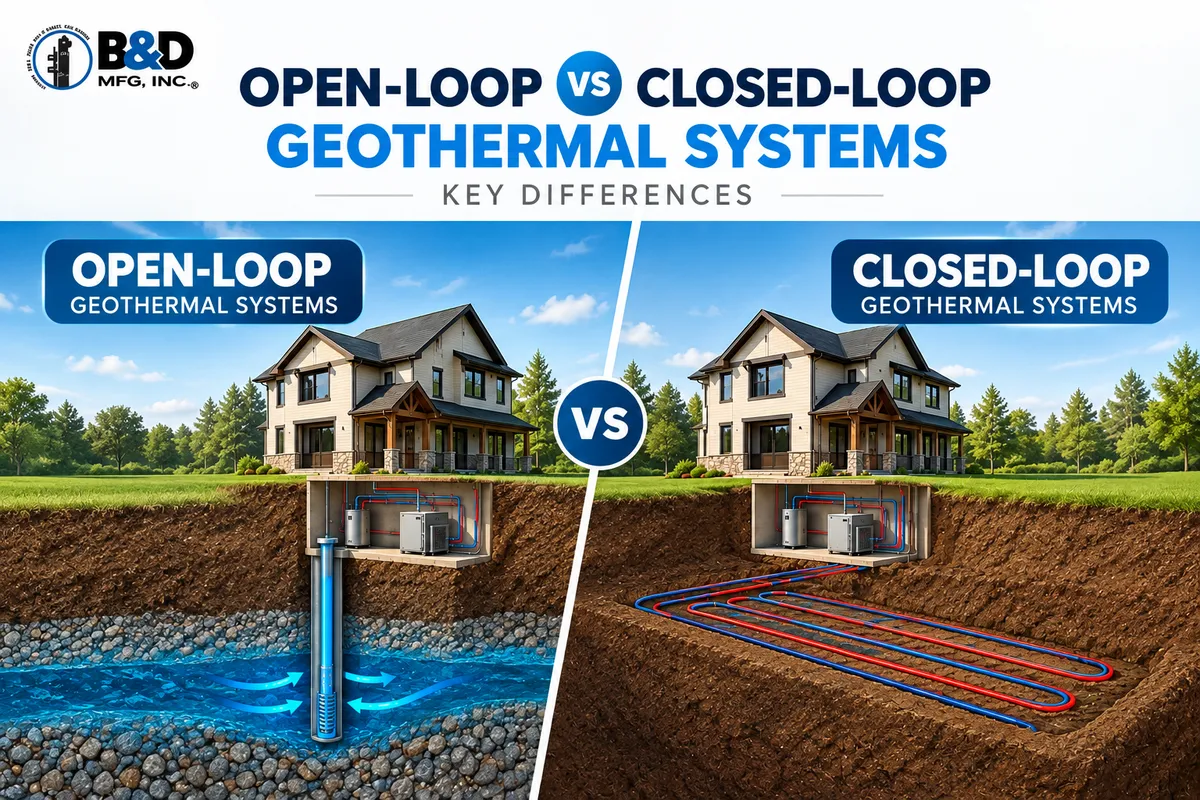
Open-Loop vs Closed-Loop Geothermal Systems: Key Differences
Choosing a geothermal loop design is one of the first decisions in planning a ground source heat pump project. The two main approaches, open loop and closed loop, move heat between the earth and a building in very different ways. That difference affects the equipment you need, how the system is installed, ongoing maintenance, and how well it fits a given site.
This guide breaks down how open loop and closed loop geothermal systems work, where each one makes sense, and what to consider before choosing a direction for your next installation.
What Is a Closed-Loop Geothermal System?
A closed loop geothermal system circulates a water or water-antifreeze mixture through a sealed network of high-density polyethylene (HDPE) pipe buried in the ground or submerged in a pond. The fluid never mixes with groundwater. It absorbs or releases heat as it passes through the loop, then returns to a heat pump inside the building to complete the cycle.
Closed loop systems come in a few common configurations:
Horizontal loops, laid in trenches across a wide area of land
Vertical loops, installed in boreholes drilled deep into the ground
Pond or lake loops, submerged in a nearby body of water
Because the fluid stays inside the pipe at all times, closed loop systems depend heavily on the quality of the pipe, fittings, and fusion joints used to build the loop. Leak-free HDPE connections are what keep the system sealed and running efficiently for decades.
What Is an Open-Loop Geothermal System?
An open loop geothermal system draws water directly from a well, aquifer, or other groundwater source, runs it through the heat pump to exchange heat, and then discharges it, typically to a second well, a pond, or another approved point of return. Unlike a closed loop, the water is used once per pass rather than being recirculated indefinitely.
Open loop systems rely on a reliable, adequate water source and generally require permits and water quality testing before installation. Local and state regulations often govern how water can be withdrawn and discharged, so site evaluation is an important early step.
Open Loop vs Closed Loop: Side-by-Side Comparison
Factor | Closed-Loop System | Open-Loop System |
|---|---|---|
Water source | Recirculated fluid in a sealed pipe loop | Groundwater from a well or aquifer |
Core materials | HDPE pipe, fused fittings, header assemblies | Well casing, pump, supply and return piping |
Land or site needs | Trenching or drilling; horizontal, vertical, or pond layout | Access to a suitable well or water body |
Permitting | Generally simpler; varies by loop type and location | Often requires water rights and discharge permits |
Maintenance | Minimal once installed; sealed system | Periodic well and water quality maintenance |
Water quality sensitivity | Not affected by groundwater mineral content | Performance can be affected by water hardness or sediment |
Typical best fit | Most residential and commercial sites, especially where water rights are limited | Sites with abundant, good-quality groundwater and supportive permitting |
Both approaches can deliver efficient, long-lasting heating and cooling when they're designed and installed correctly for the site. The right choice usually comes down to available land, water access, local regulations, and long-term maintenance preferences.
Which System Is Right for Your Project?
A few questions help narrow the decision early in project planning:
Is there a dependable groundwater source on or near the site, and are water rights available for withdrawal and discharge?
How much land is available for trenching or drilling, and what does the local geology support?
What do local and state regulations require for open loop permitting in this area?
What level of long-term maintenance is the property owner prepared to manage?
Because closed loop systems are sealed, they tend to be the more common choice where groundwater access is uncertain or tightly regulated. Open loop systems can offer strong efficiency where water is plentiful and permitting is straightforward.
Why Pipe and Fitting Quality Matters in Either System
In a closed loop system, the integrity of every fused HDPE joint determines whether the loop stays sealed for the life of the system. That makes fusion equipment and connector quality central to a successful installation.
In an open loop system, the supply and return piping still needs to handle continuous water flow reliably, so material and fitting quality remain important even though the loop itself isn't sealed in the same way.
B&D Mfg. supplies the HDPE fusion equipment and geothermal pipe connectors that installers rely on to build durable, leak-resistant loops for both residential and commercial ground source heat pump projects.
Building a Closed-Loop System? See the fusion machines and geothermal pipe fittings B&D Mfg. offers for reliable, leak-free HDPE loop installations. |
Frequently Asked Questions
Which is more efficient, open loop or closed loop geothermal?
Both can be highly efficient when properly designed. Open loop systems sometimes have an efficiency edge because groundwater temperature is often more stable, but closed loop systems close that gap with proper loop sizing and are far less dependent on local water conditions.
Does an open loop geothermal system waste water?
The water is returned to the ground, typically through a discharge well or an approved surface water body, rather than consumed. It isn't sent to a drain or sewer. Local regulations govern how and where that discharge happens.
Which system costs less to maintain over time?
Closed loop systems generally require less ongoing maintenance since the fluid is sealed and recirculated. Open loop systems need periodic attention to the well, pump, and water quality to keep performance consistent.
Can I switch from an open loop to a closed loop system later?
It's possible, but it typically means installing a new loop rather than modifying the existing one, since the two designs use different equipment and site layouts. It's usually more cost-effective to choose the right design during initial planning.
What pipe material is used in closed loop geothermal systems?
High-density polyethylene (HDPE) pipe is the standard choice for closed loop geothermal systems because it resists corrosion, handles fusion welding for leak-free joints, and holds up well underground for decades.
Need Help Planning Your Geothermal Loop? Talk to B&D Mfg. about fusion equipment, geothermal pipe connectors, and flow center solutions built for horizontal, vertical, and pond loop installations. |