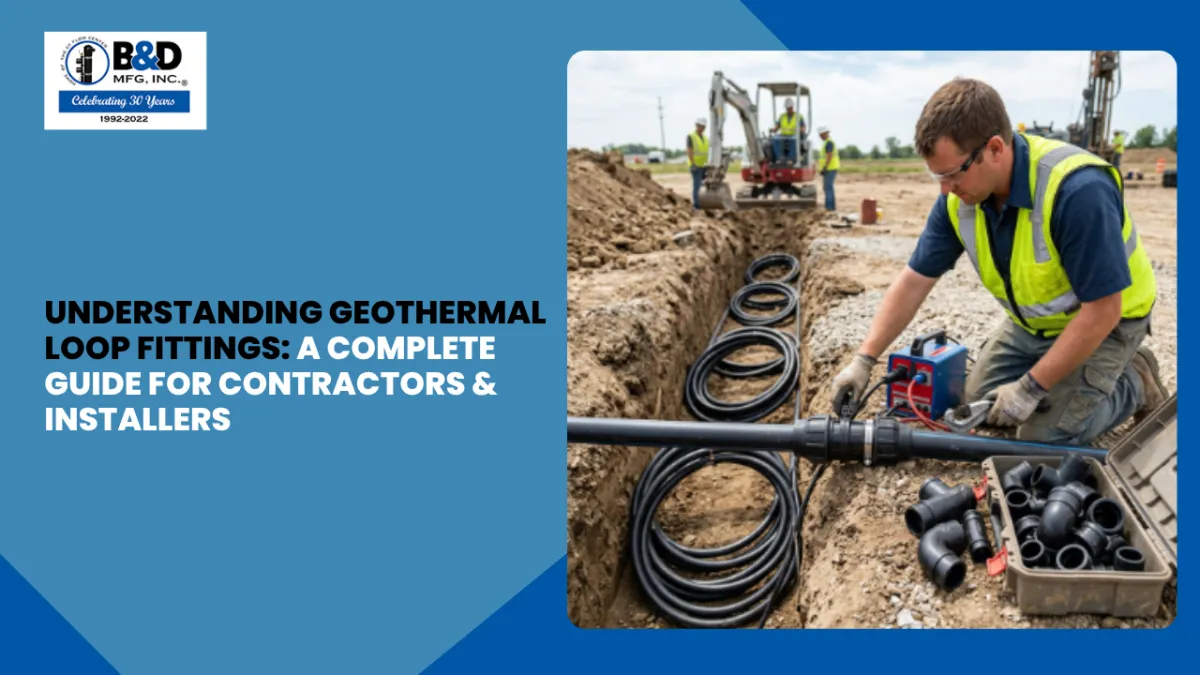
Understanding Geothermal Loop Fittings:A Complete Guide for Contractors & Installers
Whether you are designing your first closed-loop geothermal system or your hundredth, the fittings and connectors you choose determine the long-term integrity of the entire earth loop. A single failed joint buried six feet underground can cost thousands in remediation — which is why understanding geothermal loop fittings, the methods used to join them, and how to select the right geothermal connectors for each application is foundational knowledge for any geothermal professional.
This guide walks through everything you need to know: what geothermal loop fittings are, the three primary HDPE fusion methods, how to match fittings to system design, and what to look for in a supplier.
Browse the full product line: B&D Mfg. Geothermal Loop Products
What Are Geothermal Loop Fittings?
Geothermal loop fittings are the mechanical and fusion-jointed components used to connect sections of ground loop pipe typically high-density polyethylene (HDPE) within a closed-loop geothermal heat pump system. They include elbows, tees, reducers, end caps, flange adapters, sidewall saddles, and transition fittings that connect HDPE to other materials such as stainless steel, PVC, or brass.
Unlike above-ground plumbing where a leaking joint can be repaired with minimal disruption, geothermal loop fittings must function reliably for the 25–50 year life of the geothermal system with zero access for inspection once backfilled. This demands a completely different standard of joint integrity.
💡 Key Insight: HDPE geothermal loop fittings joined through heat fusion create a monolithic bond the joint is as strong or stronger than the pipe itself. There are no gaskets to degrade, no threads to strip, and no sealants to dry out underground.
→ See all HDPE fitting types: B&D Mfg. HDPE Fittings Program
Why HDPE Is the Material of Choice for Geothermal Loop Fittings
High-density polyethylene (HDPE) dominates geothermal loop applications for a combination of engineering and practical reasons:
Corrosion resistance HDPE is inert to soils, groundwater chemistry, and geothermal heat transfer fluids including glycol solutions
Flexibility HDPE pipe and fittings can flex without cracking in thermally expanding and contracting soils
Fusion jointing heat fusion eliminates mechanical connectors underground, removing the most common failure points
Long service life HDPE pipe is rated for 50+ years in buried geothermal applications when installed correctly
Pressure rating HDPE fittings for geothermal loop work are SDR-rated (Standard Dimension Ratio) for consistent wall thickness and pressure capacity
Chemical compatibility compatible with the full range of antifreeze and corrosion inhibitor solutions used in geothermal systems
The Three HDPE Fusion Methods for Geothermal Loop Fittings
HDPE geothermal fittings are joined using one of three heat fusion methods. Each has specific applications, equipment requirements, and ideal conditions. Understanding all three helps you select the right approach for each phase of a geothermal installation.
1. Butt Fusion The Standard for Geothermal Loop Systems
Butt fusion is the most widely used method for joining HDPE geothermal loop fittings and pipe. Two HDPE surfaces are simultaneously heated on a flat plate until they reach fusion temperature, the plate is removed, and the surfaces are pressed together under controlled pressure to form a full-diameter joint.
Best for: Main loop runs, header connections, and any straight or branching connection where a fusion machine can access both pipe ends.
Common butt fusion geothermal loop fittings include:
Tees (1" through 8") for branching loop circuits
Elbows and reducing tees for directional changes
End caps for loop terminations
Wye fittings for angled branch connections
Flange adapters (1" through 24") for mechanical equipment connections
Sidewall saddles for branch taps into existing pipe
Transition fittings for connecting to MPT, PVC, and stainless steel
🔧 Installation Note: Butt fusion requires the pipe ends to be clean, square-cut, and properly faced before heating. Always follow manufacturer heat time charts for the specific pipe material and diameter. B&D Mfg. provides butt fusion heat time sheets for all major brands including Nupi, Central, and J-M Manufacturing fittings.
→ View butt fusion geothermal fittings: B&D Mfg. HDPE Butt Fusion Fittings
2. Socket Fusion Ideal for Smaller Diameters
Socket fusion geothermal connectors use a fitting with a socket that receives the pipe end. Both the socket interior and pipe exterior are heated simultaneously on a spigot-and-socket heating tool, then joined together to form the bond.
Best for: Smaller diameter geothermal loop fittings (typically up to 2") and installations where space is limited or a butt fusion machine cannot be positioned.
Socket fusion produces a clean, consistent joint that is especially valued in indoor manifold assemblies and mechanical room connections where aesthetic presentation matters alongside performance.
3. Electrofusion Field Repairs and Confined Access
Electrofusion geothermal connectors contain embedded resistance wire within the fitting itself. The pipe is inserted into the fitting and electrical current is applied, melting the interface and creating a fusion bond without external heat tools.
Best for: Field repairs of existing geothermal loops, connections in excavated trenches where fusion equipment cannot maneuver, joining wet or contaminated pipe ends, and connecting pipes of slightly different wall thicknesses.
Electrofusion is the go-to solution when a buried geothermal loop requires repair or extension without a full excavation. The fitting is self-contained and requires only an electrofusion controller, making it practical in challenging field conditions.
Geothermal Loop Fitting Fusion Method Comparison
Geothermal Connectors: Beyond Fusion Fittings
While heat-fusion HDPE fittings handle most of the underground loop, geothermal systems also rely on mechanical geothermal connectors to interface with above-ground equipment, flow centers, and heat pump units.
Compression Fittings
Compression geothermal connectors provide a no-heat mechanical joint for HDPE pipe. They are primarily used in accessible locations mechanical rooms, header connections inside buildings, and any point where future serviceability is desired. Compression fittings should not be used in direct burial applications where a fusion joint is achievable.
Brass Barb Transitions
Brass barb geothermal connectors bridge from HDPE loop pipe to the flexible hose connections required at flow centers and heat pump units. Paired with stainless steel clamps, they provide a corrosion-resistant, long-lasting connection compatible with geothermal fluid chemistry.
Typical application: Connecting HDPE supply and return loop pipe to the 1" swivel connections on B&D Mfg. non-pressurized flow centers.
Flange Adapters and Back-Up Rings
HDPE butt fusion flange adapters and ductile iron backing rings (SDR11/Epoxy coated) allow geothermal loop piping to connect directly to flanged mechanical equipment such as circulating pumps, heat exchangers, and commercial heat pump units. B&D Mfg. carries flange adapters from 1" through 24" for both residential and large commercial geothermal systems.
Shop geothermal connectors and transitions: B&D Mfg. HDPE Fittings — Compression & Transitions
How to Select the Right Geothermal Loop Fittings for Your System

Choosing the correct geothermal loop fittings is a function of pipe size, system design, installation conditions, and long-term serviceability goals. Use this framework:
Step 1 Confirm Pipe Specification
Identify the HDPE pipe SDR rating and diameter for your loop design. Most residential geothermal systems use ¾" or 1" SDR-11 HDPE for individual circuits and 1-¼" or 1-½" for headers. Larger commercial systems may use 2" through 4"+ main headers. Your geothermal loop fittings must match both the pipe OD and SDR to ensure proper fusion and pressure rating.
Step 2 Map Every Connection Type
Walk through the loop design and identify each connection:
Circuit-to-header tees → butt fusion tees in the appropriate size
Directional changes → butt fusion elbows or fabricated bends
Header-to-flow-center connection → brass barb or swivel transition
Multi-circuit distribution → underground parallel header or manifold
Bore field terminations → butt fusion end caps
Equipment room connections → compression fittings or flange adapters
Step 3 Match Fusion Method to Access Conditions
For open trench installations with clear pipe-end access, butt fusion is the preferred method. For tight mechanical rooms or small-diameter work, specify socket fusion fittings. Reserve electrofusion geothermal connectors for field modifications and repairs.
Step 4 Verify Fluid Compatibility
If your closed-loop system uses antifreeze (propylene glycol, methanol, or ethanol blends), confirm that all geothermal connectors and fittings including any brass barb transitions and compression fittings are rated for the specific fluid concentration. HDPE pipe and fittings are broadly compatible with geothermal heat transfer fluids, but mechanical connectors with elastomeric seals require material-specific verification.
✅ Pro Tip: B&D Mfg. non-pressurized flow centers allow easy antifreeze addition through the air elimination chamber lid. No special pressurization equipment or flush procedures are required for indoor manifold installations a significant time savings on residential jobs.
→ Explore non-pressurized flow centers: B&D Mfg. Non-Pressurized Geothermal Flow Centers
Geothermal Loop Headers: Connecting Multiple Circuits
When a geothermal system uses multiple bore holes or horizontal loop circuits, an underground header or manifold brings individual circuits together into a single supply and return run to the flow center. Proper header design is critical for balanced flow across all circuits unbalanced flow reduces system efficiency and can lead to uneven heat transfer across the bore field.
B&D Mfg. underground headers for geothermal loop systems include:
Parallel Underground Headers 1-¼", 1-½", or 2" inlet with ¾" or 1" outlets for each circuit
ALT 180 Underground Headers 1-¼" or 2" inlet for alternative parallel circuit configurations
Headers ordered individually (not pairs) for flexible circuit count design
All B&D underground headers are HDPE-compatible and designed for direct burial alongside geothermal loop piping. They can be butt-fusion connected into the main loop run for a leak-free, monolithic underground assembly.
→ View underground header options: B&D Mfg. Underground Headers & Manifolds
Common Mistakes with Geothermal Loop Fittings (and How to Avoid Them)

Using the Wrong SDR Rating
Mismatching pipe SDR and fitting SDR is one of the most common errors in geothermal loop installation. SDR-11 fittings must be joined to SDR-11 pipe. Using SDR-17 pipe with SDR-11 fittings produces an uneven melt zone during fusion, resulting in a weak joint. Always verify SDR specifications before ordering fittings.
Applying Thread Tape or Pipe Dope to Swivel Connections
Swivel connections on B&D Mfg. flow centers use O-ring seals and are designed to be hand-tight only. Applying pipe dope or PTFE tape to swivel connections distorts the O-ring seating surface and causes leaks. These connections rely on face-seal O-rings — no sealant is needed or appropriate.
Using Mechanical Geothermal Connectors in Direct-Burial Applications
Compression fittings and threaded mechanical connectors are suitable for accessible, above-ground locations. Burying mechanical geothermal connectors without a service access point is poor practice — thermal cycling, soil movement, and corrosion can eventually cause failures that require costly excavation to repair.
Skipping Air Elimination After Filling
Air trapped in a geothermal closed loop reduces flow rate, causes pump cavitation, and degrades heat transfer. B&D Mfg. non-pressurized flow centers provide continuous air elimination through the canister design — but the system must be properly filled and the canister level checked (to the bottom of the elbow on GT models; top of the elbow on QT models).
B&D Mfg. Geothermal Loop Fittings & Connectors: Product Guide
B&D Manufacturing, Inc. offers a complete product line for geothermal loop systems with no order minimum you order exactly what each job requires.
HDPE Butt Fusion Fittings Tees, elbows, end caps, wyes, flange adapters, reducers, sidewall saddles, and transitions in sizes from 1" through 24"
HDPE Socket Fusion Fittings Couplings, elbows, tees, and caps for small-diameter geothermal loop connections
HDPE Electrofusion Fittings Couplings and fittings for field repairs and confined-access geothermal loop connections
Compression Geothermal Connectors Mechanical fittings for above-ground and accessible indoor applications
Brass Barb Transitions HDPE-to-hose connections for flow center and heat pump interfaces
Underground Headers Parallel and ALT 180 models for multi-circuit geothermal bore field distribution
Non-Pressurized Flow Centers GT, QT, XT, KFC, EA, and QT-EA models for complete geothermal loop pumping stations
→ Full product catalog: B&D Mfg. Geothermal Product Line
→ HDPE Geothermal Loop Products landing page: HDPE Geothermal Loop Products — Flow Centers & Fittings
Conclusion
Geothermal loop fittings are not a commodity purchase they are the connective tissue of a system designed to run for decades underground without a second chance for repair. Understanding the three HDPE fusion methods, matching fittings to pipe specification and installation conditions, and avoiding common installation mistakes are the building blocks of a geothermal loop that delivers reliable, efficient performance for the life of the system.
B&D Mfg., Inc. has built its reputation on providing the components that make that reliability possible from butt fusion tees and electrofusion connectors to factory-packaged non-pressurized flow centers that simplify installation and long-term service.
📞 Ready to order or have a system design question? Contact the B&D Mfg. sales team at 866-646-6724 or email [email protected]. Distributor pricing available with no order minimum.