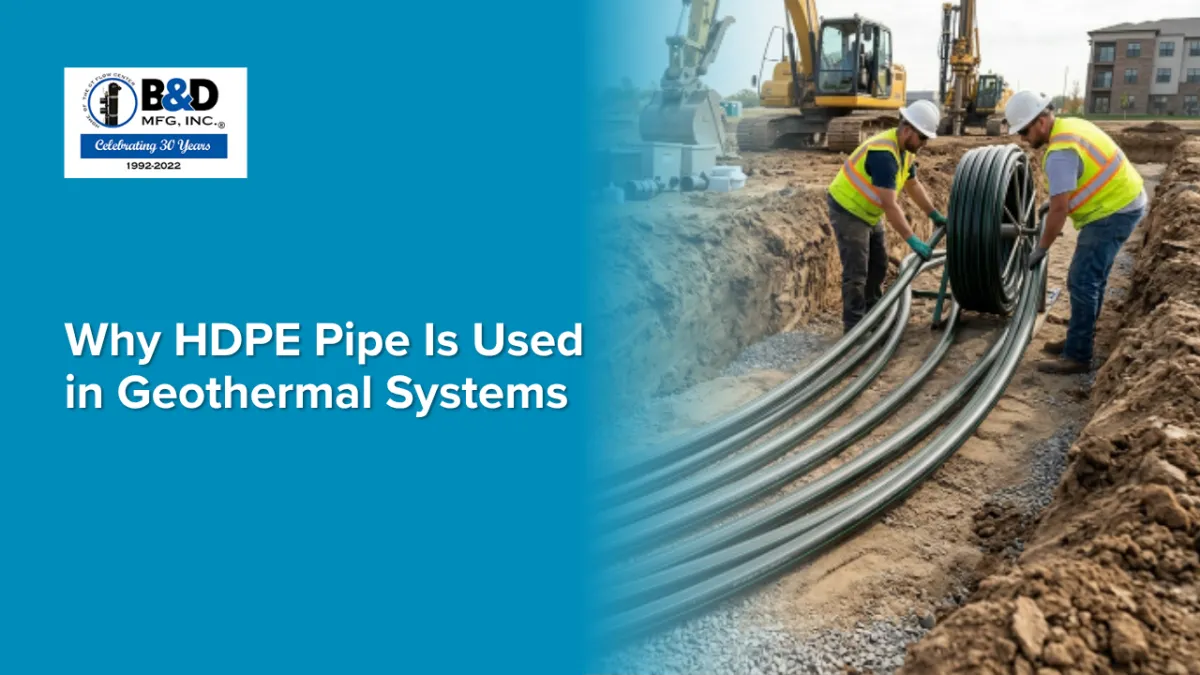
Why HDPE Pipe Is the Industry Standard for Geothermal Loop Systems
If you've ever wondered why HDPE geothermal pipe shows up on virtually every geothermal loop installation, residential, commercial, or agricultural, the answer comes down to performance, longevity, and engineering logic. High-density polyethylene (HDPE) isn't just a popular choice in the geothermal industry. It's the standard. And for good reason.
At B&D Manufacturing, we supply a comprehensive line of Geothermal Loop Products designed specifically for the demands of closed-loop ground-source heat pump systems. In this post, we'll break down exactly what makes HDPE the material of choice for geothermal loop piping, how it performs underground over decades of use, and what installers and distributors should know when selecting pipe for a geothermal project.
Ready to source HDPE geothermal pipe for your next project?
Browse B&D's Geothermal Loop Products
What Is HDPE Pipe and Why Does It Matter in Geothermal?
High-density polyethylene (HDPE) is a thermoplastic polymer known for its high strength-to-density ratio, chemical resistance, and flexibility across a wide temperature range. In the context of geothermal loop piping, it serves as the conduit through which a water-antifreeze solution circulates between the ground and the heat pump unit inside a building.
The geothermal loop is the heart of any ground-source heat pump system. It's buried underground, either horizontally in trenches or vertically in boreholes, and must function reliably for the life of the building, often 25 to 50 years or longer. The pipe used in these loops must withstand soil movement, freeze-thaw cycles, ground pressure, and continuous fluid circulation without leaking, cracking, or degrading.
HDPE checks every one of those boxes. No other commonly available pipe material combines the flexibility, corrosion resistance, thermal performance, and fusion-weld capability that HDPE brings to geothermal installations.
6 Key Reasons HDPE Is the Standard Material for Geothermal Loop Piping
1. Exceptional Durability and Service Life
HDPE pipe is engineered to last. When properly installed, HDPE geothermal pipe has a service life well in excess of 50 years underground. Unlike metal pipe, it does not rust, corrode, or react with soil minerals or groundwater chemistry. Unlike PVC or CPVC, it does not become brittle over time or crack under freeze-thaw stress.
For geothermal loops, which are buried and inaccessible once the system is commissioned, this long service life is non-negotiable. Replacing a failed loop field means excavating your landscaping, driveway, or parking lot. HDPE's durability effectively eliminates that risk.
2. Heat Fusion Joints: No Leak Points
One of the most important engineering advantages of HDPE geothermal pipe is how it's joined. HDPE pipe is connected using heat fusion, either butt fusion or socket fusion, which melts the pipe material together to create a joint that is molecularly bonded and leak-free.
Traditional pipe fittings rely on glues, gaskets, or mechanical connections, all of which can fail over time, especially under constant pressure and temperature cycling. Heat-fused HDPE joints, by contrast, are effectively one continuous piece of pipe. There are no weak points.
B&D Manufacturing stocks a complete range of HDPE fittings engineered for this purpose, including socket fusion and butt fusion options that give installers clean, code-compliant joints every time.
3. Flexibility That Works With the Earth
Soil is not static. It expands, contracts, and shifts with temperature and moisture changes. A rigid pipe installed underground is subject to stress at every joint and bend when the surrounding ground moves.
HDPE geothermal pipe is flexible enough to move with the soil rather than resist it. This flexibility also simplifies installation, HDPE can be uncoiled and laid into trenches around curves and corners without requiring elbow fittings at every direction change. B&D supplies HDPE in both coiled and straight-length configurations to support both horizontal and vertical loop installations.
4. Superior Thermal Transfer Properties
The entire purpose of geothermal loop piping is to transfer heat energy between the fluid circulating inside the pipe and the surrounding ground. HDPE offers a favorable balance of thermal conductivity and wall thickness that supports efficient heat exchange.
Additionally, HDPE's smooth interior bore minimizes friction loss in the fluid loop, allowing circulation pumps to operate at lower energy consumption. This efficiency compounds over years of operation and contributes to the overall energy savings geothermal systems are known for.
5. Chemical Resistance and Environmental Safety
Geothermal loop fluid typically contains antifreeze either propylene glycol or methanol, to prevent freezing in cold climates. HDPE is chemically compatible with these solutions and will not degrade, swell, or leach contaminants as a result of long-term exposure.
HDPE also does not react to the wide variety of soils, clays, and groundwater conditions it may be buried in across different geographic regions. Whether installed in acidic coastal soils or alkaline inland environments, HDPE maintains its structural and chemical integrity.
From an environmental standpoint, HDPE is a safe choice. It is non-toxic, recyclable, and does not introduce harmful substances into surrounding soil or groundwater.
6. Industry Standards and Code Compliance
HDPE pipe for geothermal applications is manufactured to recognized ASTM and IGSHPA (International Ground Source Heat Pump Association) standards. These standards govern pipe dimensions, pressure ratings, material specifications, and installation practices.
Using HDPE geothermal pipe that meets these standards ensures compatibility with system designs, proper pressure ratings for loop depth and pump pressure, and compliance with local and state mechanical codes. B&D Manufacturing's Geothermal Loop Products are sourced and supplied to these specifications, giving installers and distributors confidence in every order.
Looking for HDPE fittings, valves, or straight lengths for your loop field?
View B&D's Full Geothermal Product Catalog
Types of Geothermal Loop Configurations and How HDPE Performs in Each
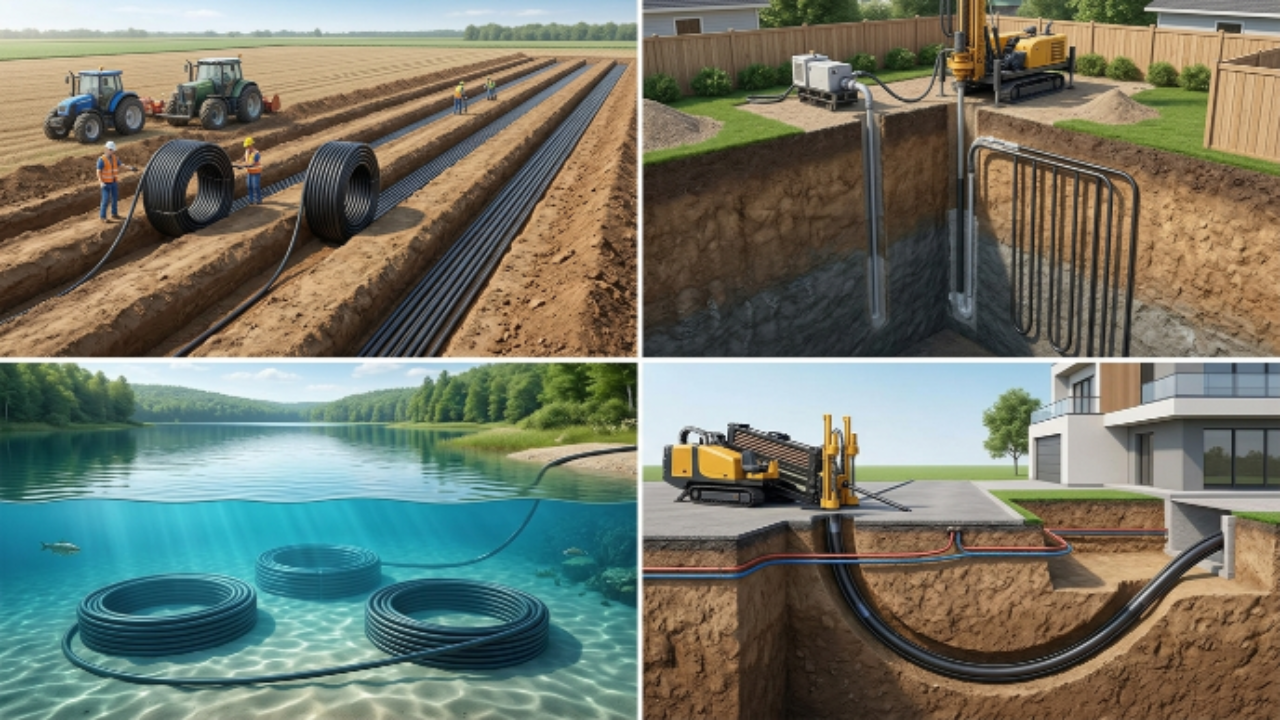
Horizontal Loops
Horizontal geothermal loops are buried in trenches, typically 4 to 6 feet deep. They require more land area than vertical loops but are generally less expensive to install. HDPE coils are ideal for horizontal installations — the pipe is flexible enough to be unrolled into trenches efficiently and maintains its shape after burial.
Vertical Loops
Vertical geothermal loops are installed in boreholes drilled 150 to 400 feet deep. HDPE straight lengths or prefabricated U-bend loops are lowered into the borehole and grouted in place. HDPE's pressure ratings accommodate the depth and hydrostatic pressure of deep vertical installations without issue.
Pond and Lake Loops
Where a body of water is available, pond loops use coiled HDPE sunk to the bottom of a lake or pond. HDPE's buoyancy characteristics and resistance to aquatic environments make it well-suited for this application.
Horizontal Directional Drilling (HDD)
In retrofit applications or where surface disruption must be minimized, HDPE pipe can be pulled through directionally drilled bores. HDPE's flexibility and fusion-welded continuous lengths allow it to be pulled through curved bores without joint failures.
What to Look for When Selecting HDPE Geothermal Pipe
Not all HDPE pipe is equal. When specifying or purchasing HDPE for geothermal loop piping, consider the following:
SDR Rating: The Standard Dimension Ratio determines wall thickness relative to pipe diameter. SDR 11 is the most common specification for geothermal loops, providing a balance of pressure rating and material efficiency.
Diameter: Common geothermal loop diameters range from 3/4" to 1-1/4" for residential systems and up to 2" or larger for commercial applications.
Coiled vs. Straight Lengths: Coiled pipe is convenient for horizontal loops; straight lengths are used for vertical boreholes and header piping.
IGSHPA Compliance: Confirm pipe specifications meet IGSHPA standards for geothermal applications.
Source and Quality Assurance: Purchase from established suppliers who can document material specifications and traceability.
B&D Manufacturing supplies HDPE pipe, fittings, valves, and accessories that meet these benchmarks whether you need coils for a residential project or bulk straight lengths for a large commercial loop field.
Need straight lengths, coils, or HDPE poly valves for a commercial loop field?
Contact B&D's Sales Team at 866-646-6724
HDPE Geothermal Pipe and the Full B&D Loop System
At B&D Manufacturing, HDPE geothermal pipe is one part of a complete geothermal loop product line that includes everything an installer or distributor needs to build a high-performing closed-loop system:
Straight Lengths & Coils, HDPE pipe in configurations suited for horizontal, vertical, and pond loop applications
HDPE Fittings, Socket fusion, butt fusion, and poly valve options for leak-free connections
Valves, Flushing valves, poly valves, brass-threaded valves, and more for system control and maintenance
Flow Centers, Pump packages to circulate loop fluid efficiently between the ground loop and the heat pump
Geothermal Expansion Tanks, For system pressure management
Grundfos Pumps, 115V and 230V options for circulation in a wide range of system sizes
This integrated product offering means you can source all geothermal loop piping components from a single, trusted supplier, simplifying procurement, ensuring compatibility, and reducing lead time on projects.
How HDPE Compares to Alternative Pipe Materials
Frequently Asked Questions
Why is HDPE preferred over PVC for geothermal loop piping?
HDPE's combination of flexibility, heat fusion jointing, and long-term durability makes it far superior to PVC for buried geothermal applications. PVC can become brittle over time in freeze-thaw conditions and relies on mechanical or solvent-cement joints that can fail underground. HDPE loop pipe can be heat-fused into a seamless, leak-free system with no mechanical joint failure points.
What SDR rating should I specify for geothermal HDPE pipe?
SDR 11 is the most widely specified rating for closed-loop geothermal systems. It provides the wall thickness needed for the pressure demands of residential and light commercial loop fields. Some larger commercial or deeper vertical loop applications may call for SDR 9 or specific pipe pressure classes always confirm with your system designer or engineer.
How long does HDPE geothermal pipe last underground?
When properly installed and manufactured to IGSHPA and ASTM standards, HDPE geothermal pipe is designed for a service life exceeding 50 years. Many installations from the 1980s and early 1990s are still in service today with no pipe degradation.
Does B&D Manufacturing supply HDPE pipe in both coils and straight lengths?
Yes. B&D's Geothermal Loop Products line includes HDPE pipe in both coiled and straight-length configurations. Coils are commonly used for horizontal trench installations, while straight lengths are standard for vertical borehole and header piping applications. Contact our sales team at 866-646-6724 or browse our catalog for current inventory and lead times.
Can HDPE pipe handle the antifreeze solutions used in geothermal systems?
Yes. HDPE is chemically compatible with propylene glycol and methanol solutions commonly used as geothermal loop fluid. It will not degrade, swell, or react with these fluids over the operating life of the system.
Where can I find B&D's geothermal product catalog?
B&D Manufacturing publishes a Geothermal Catalog (Volume 8) and an HDPE Fittings Catalog (Volume 1) available through our website at bdmfginc.com. Distributors can also request catalogs and access the current distributor price sheet by contacting our sales department.
Source HDPE Geothermal Pipe from a Trusted Manufacturer
B&D Manufacturing has been supplying geothermal loop products to distributors and contractors across North America for decades. From HDPE pipe and fittings to flow centers, valves, and Grundfos pumps, we carry the full system.
Shop Geothermal Loop Products at bdmfginc.com →
Or call our sales team: 866-646-6724