How Deep Should a Geothermal Ground Loop Be?
There is no single answer to how deep a geothermal ground loop needs to be. The right depth depends almost entirely on which loop configuration is going into the ground: horizontal, vertical, or pond or lake. Each one taps into the earth's stable temperature a different way, and each comes with its own depth range, installation method, and site requirements.
This guide breaks down typical geothermal ground loop depth ranges by loop type, the factors that push depth up or down on a given job, and where fittings and connections come into play once the loop goes underground.
Why Loop Depth Matters
Ground temperature stays relatively constant once you get below the zone affected by seasonal air temperature swings. Digging or drilling to the right depth is what allows a closed loop system to draw on that stable temperature year round instead of chasing the surface temperature, which swings with the weather. Too shallow, and the loop performs more like an air source system. Deep enough, and it delivers the consistent heat exchange a ground source heat pump depends on.
Depth by Loop Type
Here is how the three most common closed loop configurations compare on depth:
Horizontal Loop Depth
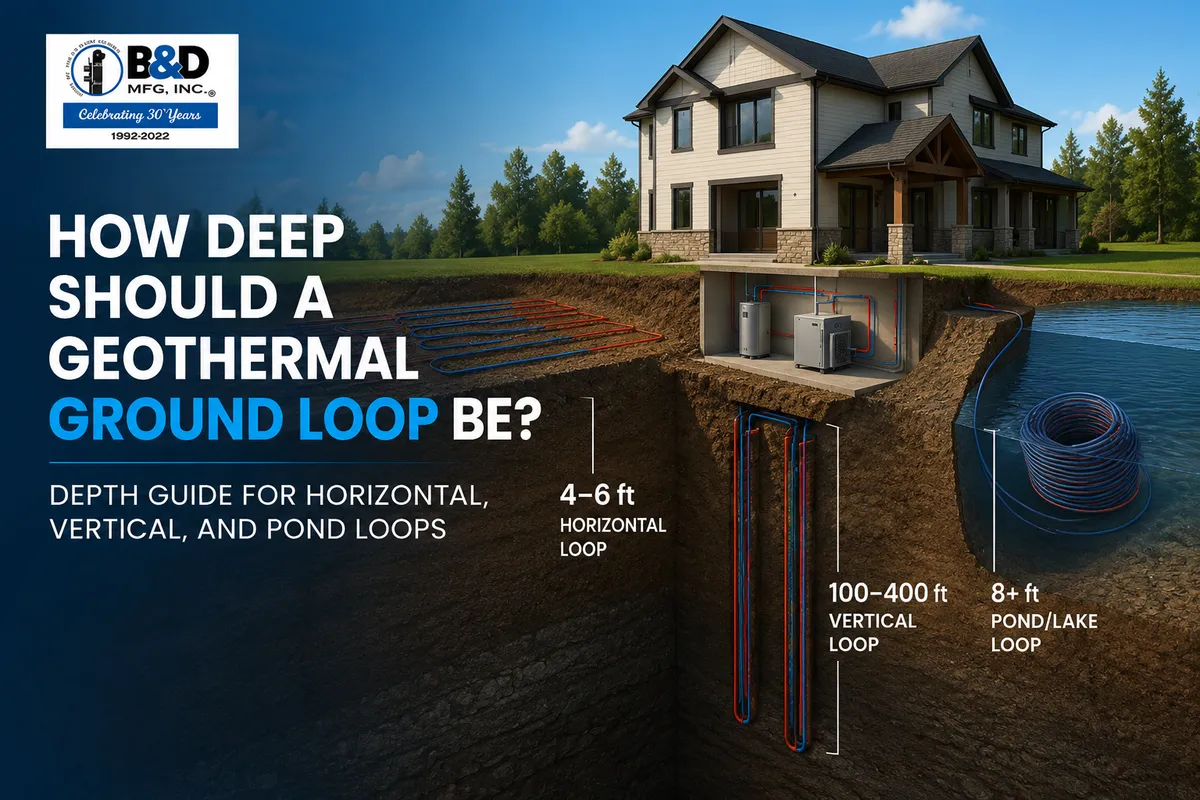
Horizontal loops are installed in trenches, typically 4 to 6 feet below grade and below the local frost line. Some designs place two pipes in the same trench at slightly different depths, such as one pipe at 6 feet and a second at 4 feet, to fit more pipe length into a shorter trench run. Because horizontal loops sit relatively close to the surface, they need enough open land to accommodate several hundred feet of trenching per ton of heating and cooling capacity.
Vertical Loop Depth
Vertical loops are installed in boreholes drilled straight down, commonly ranging from 100 to 400 feet deep depending on soil and rock conditions, with individual boreholes spaced roughly 15 to 20 feet apart. A U-shaped HDPE pipe assembly runs down each borehole and back up, and the borehole is grouted afterward to keep the pipe in solid thermal contact with the surrounding earth. Because the loop reaches deeper, more thermally stable ground, vertical systems need far less surface area than horizontal loops, which is why they show up so often on tight urban lots, schools, and commercial sites. The individual borehole loops then tie into an underground header before running to the flow center.
Pond or Lake Loop Depth
When a suitable water body is available on site, coiled HDPE pipe can be submerged at least 8 feet below the surface to stay below the frost line and avoid interference from boat traffic or fluctuating water levels. This option skips trenching or drilling altogether, but it only works where the pond or lake is large and deep enough to handle the heat exchange load without excessive temperature swings.
Factors That Influence Depth Decisions
A geothermal designer or driller weighs several site specific factors before settling on a final depth:
Local frost line, which sets the minimum depth for any horizontal trench
Soil and rock composition, since thermal conductivity affects how much pipe length or borehole depth is needed
Available land area, which often decides whether horizontal or vertical makes more sense
Groundwater levels and local drilling regulations, especially for vertical boreholes
Total heating and cooling load of the building being served
Fittings and Connections at Depth
Whatever the depth, the pipe joints below grade have to hold up for decades without a chance for repair. That is why HDPE butt fusion fittings are the standard for the straight pipe runs and boreholes themselves, creating a fused joint that is as strong as the pipe on either side. Where individual loops come together above the boreholes or trenches, an underground header consolidates multiple circuits into a single supply and return run before it reaches the flow center. For a closer look at how these components fit together, see our guide to understanding geothermal loop fittings.
Frequently Asked Questions
How deep does a horizontal geothermal loop need to be?
Horizontal loops are typically installed 4 to 6 feet below grade, always below the local frost line. Some layouts stack two pipes in the same trench at different depths to maximize pipe length per foot of trench.
How deep are vertical geothermal boreholes drilled?
Vertical boreholes commonly range from 100 to 400 feet deep, depending on soil and rock conditions and the building's heating and cooling load. Boreholes are typically spaced 15 to 20 feet apart.
Does a deeper loop always mean better performance?
Not necessarily. Depth needs to match the loop type and the site's ground conditions. A properly sized horizontal loop at 4 to 6 feet can perform just as reliably as a vertical system, provided there is enough land and pipe length to handle the load.
What determines whether a site uses a horizontal or vertical loop?
Available land is usually the deciding factor. Horizontal loops need enough open space for trenching, while vertical loops are the go to choice on smaller lots or sites where drilling equipment can access the area but trenching cannot.
Need Fittings for Your Next Geothermal Job?
B&D Mfg. supplies the HDPE fittings, headers, and flow centers that hold up at any loop depth, from shallow horizontal trenches to deep vertical boreholes. Browse the full geothermal product line or reach out to our team to spec fittings for your next installation.